English
 中文简体
 Tiếng Việt
Production of various high-end fabrics reaches 7 million meters annually, including a wide range of fashionable new products and exquisite items, with a broad coverage of color patterns.

Tencel Fiber Explained: Lyocell vs Modal, Blends and Sourcing Checks for Buyers
2026-11-25
Content
A purchase order that simply says Tencel fiber is not specific enough to weave from. Tencel is a brand name covering two different regenerated cellulosic fibers, lyocell and modal, and the gap between them shows up in tenacity, in the dye bath and in the final shrinkage figure. Mills that treat the two as interchangeable usually discover the difference at the finished-roll stage, one reorder too late.
What Tencel Fiber Actually Is
Tencel is the brand name Lenzing AG uses for its lyocell and modal fibers, both spun from dissolving-grade wood pulp and both classified as regenerated cellulosic fibers rather than natural or fully synthetic ones.
Definition: Tencel fiber is a man-made cellulosic staple fiber produced by dissolving wood pulp, regenerating the cellulose into continuous filament and cutting it into staple lengths for spinning on cotton, worsted or blended systems.
Three facts shape how the fiber behaves once it reaches the loom:
- The polymer is cellulose, so the fiber takes reactive dyes on the same range as cotton and shares cotton's moisture behavior.
- The physical form is staple, usually 1.3 to 1.7 dtex and 38 mm, which ring-spins or compact-spins well alone or in blends.
- The spinning route, not the brand name alone, decides fibrillation, strength and price.
Lyocell and modal behave differently
Lyocell is the stronger, leaner fiber; modal is the softer, cheaper one. They are rarely interchangeable in a greige construction.
| Attribute | Lyocell | Modal |
| Spinning route | Direct solvent dissolution, dry-jet wet spinning | Modified viscose route, xanthation and acid bath spinning |
| Dry tenacity | Around 4.0 to 4.2 cN/dtex | Around 2.6 to 3.0 cN/dtex |
| Wet strength retention | Roughly 80 percent | Roughly 60 to 65 percent |
| Hand and drape | Cool, dry touch with a lean drape | Soft, slightly warmer, more body |
| Fibrillation | Pronounced under wet abrasion unless finished | Low |
| Typical end use | Shirting, bedding, twill, workwear | Underwear, jersey, lining, soft blends |
Brand name versus generic name
The generic name, lyocell or modal, must appear on content and care labels, while Tencel can only be claimed when the yarn contains certified Lenzing fiber. If a purchase order asks for Tencel without a generic name or a fiber certificate, treat it as an open specification and confirm the source before sampling.
From Pulp to Staple in Four Stages
Lyocell is made by dissolving cellulose directly in N-methylmorpholine N-oxide, extruding the solution through an air gap into a water bath, then washing the filament before cutting it into staple.
- Pulp dissolving. Wood pulp sheets are swollen in the amine oxide solvent with a small amount of water, then heated and sheared until the cellulose forms a clear, spinnable dope.
- Dry-jet wet spinning. The dope passes through spinnerets across a short air gap into a coagulation bath; that gap lets the polymer chains orient, which is where lyocell gets its strength.
- Solvent recovery. The diluted solvent is distilled and returned to the line, which is why the route is described as closed loop rather than solvent free.
- Cutting to staple. The tow is washed, finished, crimped and cut to 38 mm or 51 mm so it can run on cotton or worsted systems.
In a modern lyocell line more than 99 percent of the solvent is recovered and reused. Pulp sourcing and water use, not the solvent itself, are usually the bigger sustainability questions a buyer should raise.
Modal follows a modified viscose route: steeping, xanthation and wet spinning in an acid bath. The process costs less and delivers a softer hand, but wet strength is lower and chemical recovery is less complete.
Properties That Decide How the Fabric Performs
Lyocell brings dry strength and dimensional stability, while modal brings softness and a lower fibrillation risk at a lower price per meter.
4.0-4.2cN/dtex dry tenacity, lyocell
11-13%moisture regain, both fibers
38 mmstandard staple length
Fibrillation is the check buyers forget
Wet abrasion makes lyocell fibrillate, a fine surface fuzz that becomes a grey frost on dark shades or a peach hand on shirts and bedding. Both outcomes sell, but the finish route has to be agreed before dyeing, not after.
Fibrillation is not automatically a defect. It is either a finish, the soft peach touch used on bedding and shirts, or a problem, the chalky haze on piece-dyed navy and black, and the two routes cannot be swapped at the finishing stage.
Strength, drape and crease recovery
A 60/40 cotton and lyocell twill usually carries more tear strength than the same weight in pure cotton, with better drape and less creasing after washing. Modal-rich blends feel softer but grow more in the wash, so the shrinkage figure worth asking for is the one measured after three home washes on the finished roll.
Blending Tencel with Cotton
Cotton and Tencel blends, most often 60/40, 55/45 or 85/15, pair cotton's body with cellulosic drape, and the Tencel share sets the sheen, the strength and how the cloth falls.
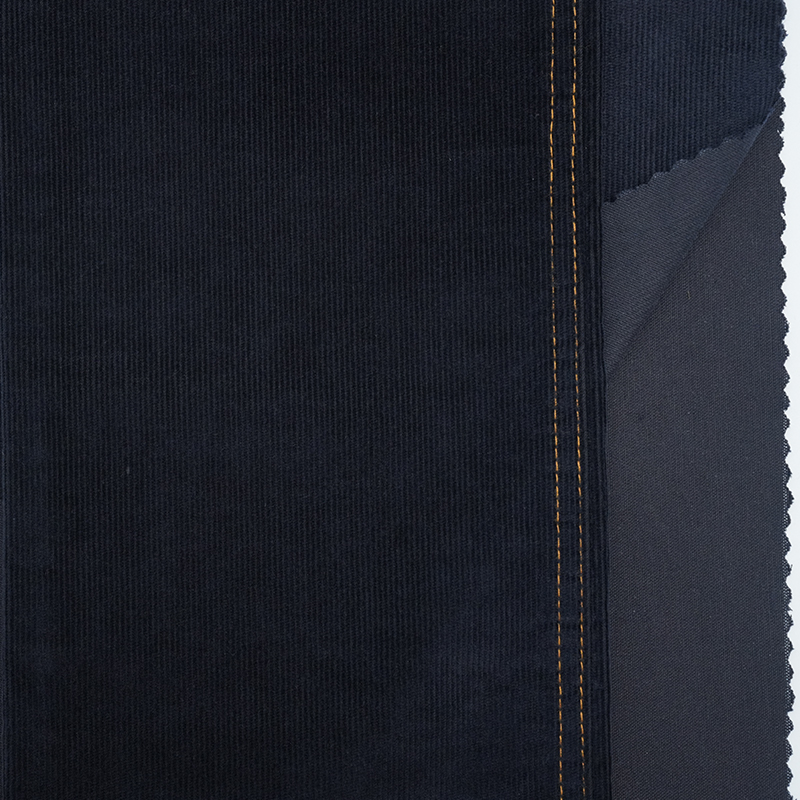 Cotton-Tencel Twill Dyed Cloth for Shirting and WorkwearThis 290 g/sm cotton-Tencel twill brings Tencel's drape and soft hand to a durable construction suited to casual wear, workwear, and fashion apparel.View Product →
On our own looms the blend runs from a 2/1 twill for shirting and workwear to a heavier canvas for bags and light upholstery, and the Tencel content is what keeps a 240 gsm canvas from feeling board-stiff. Blend ratios, dyeing behavior and shrinkage targets are covered in more detail in our guide to cotton Tencel dyed cloth.
Ratio first, fiber second. An 85/15 cotton and Tencel twill and a 55/45 blend can look identical on a hanger photo and behave like two different fabrics after ten washes.
- Higher dry strength at the same weight
- Liquid drape and a soft, dry sheen
- Less creasing after washing
- Cleaner reactive dye uptake on the cellulosic side
What to watch on the loom
- Fibrillation finish must be fixed in advance
- Higher fiber cost per meter than viscose blends
- Crease marks in rope-form wet processing
- Shrinkage claims need a finished-roll wash test
Dyeing, Finishing and Care Checks
Cotton and Tencel blends dye on standard reactive ranges; cold pad batch and exhaust at 60 C both work, and the cellulosic component takes shade quickly, so levelness depends more on pretreatment than on dye selection.
- Prepare without tension, because rope creases and rope marks are hard to remove on lyocell-rich blends.
- Keep drying temperature moderate and overfeed the stenter, since the fabric loses bulk when it is pulled hot and dry.
- Batch the fibrillation treatment before dyeing whenever a peach hand is specified.
Ask for a three-wash shrinkage figure measured on the finished roll, not on a lab swatch. A half-meter sample will always look better than the piece the cutter actually receives.
For the consumer, wash at 30 to 40 C on a normal cycle, spin low and avoid a hot tumble dry; moderate ironing on the reverse is enough. Our note on washing cotton Tencel cloth to keep its color sets out the test we run before shipping.
A Practical Sourcing Checklist
Ask for four things in writing: the generic fiber name, the blend ratio with a tolerance, the fibrillation finish, and a shrinkage figure measured on the finished roll.
- Generic name and brand status, with a fiber certificate if Tencel is claimed.
- Blend ratio stated with a tolerance, usually plus or minus 3 percent.
- Shrinkage target after three home washes, 5 percent or less in both directions.
- Colorfastness and pilling results with the test method named.
- Weight, width and construction, so a reorder can be matched to the same loom.
| Check | Typical target | How it is verified |
| Fiber name | Lyocell or modal, brand stated separately | Fiber certificate from the spinner |
| Blend ratio | Within plus or minus 3 percent of the declared figure | Laboratory fiber analysis |
| Shrinkage | 5 percent or less in warp and weft | Wash test on the finished roll |
| Colorfastness to washing | 4 or better for shade change | Standard wash fastness test |
| Pilling | Grade 3-4 or better | Martindale or pilling box |
| Surface finish | Fibrillation route agreed and written down | Visual check under raking light |
When a program needs a heavier hand, the cotton Tencel canvas below is the construction we run most often for bags and soft upholstery.
 Cotton-Tencel Ground Dyed Canvas for Bags and UpholsteryThis 269 GSM ground-dyed canvas pairs cotton strength with Tencel softness and spandex stretch for bags, soft upholstery, and durable clothing.View Product →
Put the generic name, the blend ratio and the finish on the purchase order. A lab dip cannot correct a fiber mix that was never specified in the first place.
Frequently Asked Questions
Is Tencel the same as lyocell?
Not exactly. Tencel is a brand that covers both lyocell and modal, so a Tencel garment is legally labelled under one of those two generic names. The care label tells you which fiber you actually have.
Does Tencel fabric shrink?
Less than viscose and roughly in line with cotton when the fabric is properly finished. Ask for a figure measured after three home washes on the finished roll; 5 percent or less is a fair target for a cotton and Tencel woven.
Can Tencel be machine washed and ironed?
Yes. Wash at 30 to 40 C on a normal cycle, spin low, and iron on the reverse at a moderate setting. High tumble heat is what dulls the surface and sets creases that will not press out.
Why does Tencel cost more than viscose?
The solvent route, the recovery plant and the pulp specification all cost more than a standard viscose line. The premium buys strength, a cleaner hand and a shorter chemical loop, not a different fiber family.
Bottom line: name lyocell or modal on the order, fix the blend ratio and the fibrillation finish, and test shrinkage on the roll that ships.
Related Products

-

- Address: No.8 Longxuan Road, Lijia Town, Wujin District, Changzhou, China
- Phone: +86-13301509168
- Email: [email protected]
- BE THE FIRST TO KNOW
- For exclusive deals and latest offers, sign up by entering your email address below.
- QUICK LINKS
RELATED CERTIFICATIONS: